Spoilers ahead
Scotland has a deep connection to ancient Greece. In fact, we’re often called the “Athens of the North.” Has anyone heard that before? Oh, I thought it was just us who called ourselves that. We like to think of ourselves as ancient Greece, while England is ancient Rome—a battle of intellect against brute force. And of course, intellect is always going to win, right?
There’s a lot of inspiration in Scotland, particularly in Edinburgh, drawn from mythology. That’s a sphinx.
In ancient Greek mythology, the the sphinx is a treacherous and merciless being with the head of a woman, the haunches of a lion, and the wings of a bird. According to Greek myth, she challenges those who encounter her to answer a riddle, and kills and eats them when they fail to solve the riddle. Now, can anybody tell me in which Harry Potter book the Sphinx appears? And what is the name of that book? For 100 points, who can tell me?
It appears in the third task of the Triwizard Tournament. For an extra 50 points, what do you have to do to get past the Sphinx? Answer a riddle?
So, we’ve found our first magical creature. Let’s see if we can find another one.
There’s a unicorn sitting right up there. That’s our Mercat Cross. Now, why do we have a unicorn up there? Any ideas? That’s right, it’s the national animal of Scotland. It may be imaginary, but it actually dates back to the 12th century, when the unicorn was considered one of the noblest animals.
Now, in which Harry Potter book do we first see the unicorn? Yes, exactly—the first book! I love that—50 points! When Harry is in detention in the Forbidden Forest, he asks if a werewolf could be killing the unicorns, and he’s told that werewolves aren’t fast enough. So, for an extra 100 points, who is actually killing the unicorns? No, not Fenrir Greyback.
Voldemort! Yes, that’s correct—Voldemort is killing the unicorns to drink their blood. J.K. Rowling writes that unicorn blood can keep someone who is near death alive, and their tail hairs are very potent and powerful, used in wands.

Now, I have a picture of a creature from Scottish mythology. Hold your comments for just a minute. I’ll show you this creature, and then I want you to tell me which character or creature from Harry Potter you think it inspired. This is a brownie. A brownie is a figure from Scottish folklore, said to come out at night when the owners of a house are asleep, performing farming tasks or chores around the house. The owner would leave a bowl of milk or cream as a reward. A brownie could go completely invisible or turn into an animal at will, and they often wore rags. But if you tried to present a brownie with clothing or tried to baptize it, it would leave forever, highly offended.
Now, what creature in Harry Potter is based on the brownie? That’s right, house-elves! For 50 points, which house-elf dies in the Deathly Hallows while trying to save Harry Potter? That’s correct, 50 points! And whose knife kills him? Points to you—it’s Bellatrix Lestrange’s knife. For an extra 50 points, what is the name of the house-elf Harry inherits after Sirius Black dies? Yes, that’s right—Kreacher! Excellent work!
So, Rowling took inspiration from many sources, not just Greek mythology. Interestingly, brownies are not called brownies in the Highlands and Islands of Scotland—they’re called dobies. House-elves were inspired by them.
Now, I actually have an afternoon tea date with my best friend, Dolores Umbridge. Would you like to join me? Yes? Great! But to get to the Ministry of Magic, we’ll need to dial a specific number. Does anyone know what number you have to dial to get to the Ministry? For 200 points, here’s a clue—it spells out “MAGIC” on an alphanumeric keypad. Come on, surely someone knows? It’s 62442. Great job—20 points for that!
Okay, now for a trivia question: Which members of the Weasley family work for the Ministry of Magic? Percy? That’s right, 50 points. Arthur? Yes, another 50 points! Now, for an extra 50 points, what jobs did they hold? Percy worked in several departments, but his last job was as a high-ranking official directly under the Minister for Magic. Arthur worked in the Misuse of Muggle Artifacts Office. Great job, everyone!
Now, if you look over here, you’ll see another important building. Can everyone see the one with the clock tower? That’s the Balmoral Hotel. Is anyone staying there? No, of course not—you’re all on a free tour! That’s a very expensive hotel, built in 1902 as the North British Railway Hotel. It used to serve wealthy tourists arriving in Edinburgh by train. The hotel is also where J.K. Rowling wrote the final book in the series, Harry Potter and the Deathly Hallows.
Rowling couldn’t write that seventh book in cafés anymore—by that point, she was too famous. She might have been hounded by someone trying to get her to divulge the secrets of the last book. But by then, she had plenty of money and had bought a lovely mansion outside the city. However, she found it hard to get any work done there because she had remarried in 2001, had two more children, and was renovating the mansion. So, she had a very noisy household—crying babies, construction workers, barking dogs, and a husband constantly asking where things were. She needed peace and quiet. Let’s try to imagine just how noisy it was for her. Can I hear some crying babies?
Over here, we’ve got our “walking dogs” section. Can you do some barking? And over here, we’ve got construction work—give it a try. Now, for the “annoying husbands,” say something like, “Honey, have you seen the kids anywhere?” or “I’ve been looking for the bathroom for three hours!” Okay, everyone, let’s try it all together and see how it would have sounded for her. Ready? Three, two, one—go!I love it! People always get into that. Okay, so you can imagine how impossible it would have been for her to write that book at home.
Balmoral Hotel
So, she did what any normal multimillionaire would do—she booked herself a room or a suite at the Balmoral Hotel for a week to start writing. She did this in 2006, and that first week of writing went really well. Being a bit superstitious, after that successful week, she thought, “I don’t want to jinx it. I’m just going to stay a little longer.” Don’t worry about the kids—she had nannies, and she did go home sometimes to sleep. I often get asked, “What about the children?” Well, she spent six months writing in that suite and eventually finished The Deathly Hallows in January 2007.

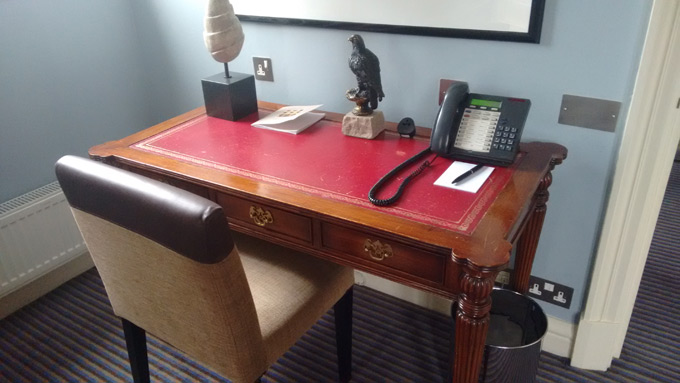
When she finished the book, she decided to throw a little party for herself and some friends. They had champagne delivered to the room, drank a bit, and kept drinking until they got a bit tipsy. Then, in a moment of rockstar madness, J.K. Rowling vandalized the room by signing the back of a statue of Hermes near the dressing table. I’ve actually got a picture of it if you don’t believe me! Here’s what she wrote: “J.K. Rowling finished writing Harry Potter and the Deathly Hallows in this room.”Now, can anyone tell me who Hermes is? He’s the messenger of the gods, associated with travel, communication, and… parcel delivery services!
But which Weasley shares a name with Hermes? This is a tough one, so it’s worth 300 points. Yes, that’s right—Percy! 300 points to you! I’ll give you an extra 100 for helping out.
So, after that little escapade, J.K. Rowling got a phone call from the hotel manager saying, “Excuse me, Mrs. Rowling, we’ve noticed a bit of damage in the room you stayed in.” She was mortified and said, “Oh my God, I’m so sorry. I’m incredibly embarrassed. What can I do to make it right?” The manager replied, “Actually, we’ve had an idea. We’d like to name that suite the ‘J.K. Rowling Suite,’ with your permission.” And that’s exactly what they did. It’s now called the J.K. Rowling Suite, room 552. You can see it there—very beautiful. It even has a typewriter and a statue of Hermes, still proudly on display. If you’ve got £1,700 a night to spare, you can stay there too!
Now, let’s move on—who here hasn’t bought all their equipment for their first year at Hogwarts yet? No worries, because we’re about to visit the most famous shopping street in the wizarding world: Diagon Alley.
Victoria Street, Diagon Alley of Edinburgh
January 20, 2024
Welcome to Victoria Street, said to be the inspiration for Diagon Alley. Now, there are a number of streets around the world that claim to be the original inspiration—there’s one in York, the Shambles in North Yorkshire, and even a place in the USA. But none have the credentials of Victoria Street.
When Diagon Alley is described in the first book, it’s portrayed as a cobbled street lined with shops, just like this one.
When J.K. Rowling lived here and frequented this shop, it wasn’t as polished as it is now. It used to be a very rustic old secondhand bookshop, with books piled high to the ceiling and the smell of old pages in the air. They’ve cleaned it up a bit since then, but this shop is said to be the inspiration behind Flourish and Blotts in Diagon Alley. If you go inside, you might find a very special edition of Harry Potter. I actually have one with me right now. Take a good look at the front cover—what’s unusual about it?It’s a Scots edition! It’s not Harry Potter and the Philosopher’s Stone at all—it’s Harry Potter written in Scots. You might be able to understand about 30 percent of what’s written in this book. A lot of people come to Scotland, buy a copy, and only realize once they’re on the plane home that they can barely read it. They think they’ve had some sort of stroke! It’s a lot of gobbledygook. If you want to play a practical joke on your Harry Potter fan friends, buy them a copy and see how long it takes them to figure out it’s not in English.
Now, we’re standing outside the Elephant House, where J.K. Rowling wrote much of the early Harry Potter books. Unfortunately, it’s no longer open—it suffered a massive fire in 2021 and hasn’t been rebuilt, likely due to insurance issues.The Elephant House was a very ordinary café, but it had something very exciting hidden inside. I’ve seen it myself—graffiti in the girls’ bathroom that read, “The Chamber of Secrets has been opened.” The boys’ bathroom even had a list of the Death Eaters. Sadly, the café is gone, but they say the bathroom wall with the graffiti survived the fire. I’m not sure how true that is, but some claim it’s still there. You can visit the site, grab a bite to eat, and relive some Harry Potter history. It’s what I call Elephant House 2.0.
Now, moving on to another spot—this place used to be something entirely different. Do you know what it was when J.K. Rowling was writing the first Harry Potter book? It was Robert Pringle’s Broom Shop, established in 1873. The family lived on the second floor, where they made brooms, selling them downstairs. This little shop inspired Quality Quidditch Supplies and even Ollivanders in the books. It’s an exciting place with a rich history.
most famous serial killers in Scotland, William Burke and William Hare
But there’s one more shop nearby that inspired a different part of Harry Potter—a shop on an eerie street, Knockturn Alley. Can anyone spot the shop that might have inspired this? Yes, that’s right—Burke and Hare. This shop has a dark history. Inside, there’s a wallet made out of human skin, which came from the most famous serial killers in Scotland, William Burke and William Hare.
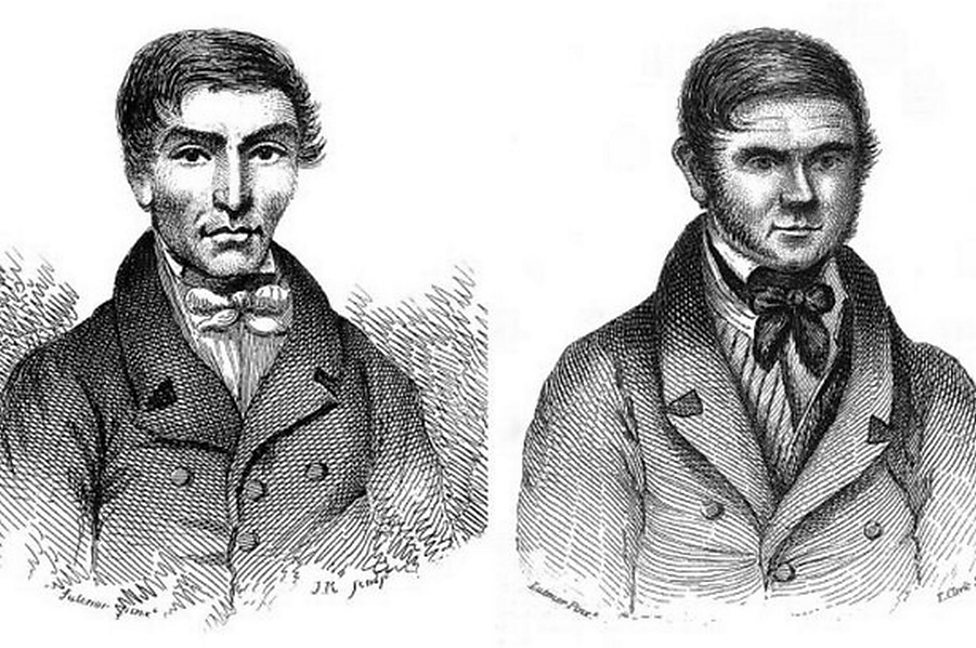
These two men would get their victims drunk until they passed out, then smother them to death. They didn’t do this just for pleasure but to sell the bodies to medical science, as Edinburgh was a leading center for anatomical research. There weren’t enough executed criminals to supply the demand for cadavers, so grave-robbing became common. Burke and Hare, however, went a step further, murdering people to sell their bodies.Eventually, evidence caught up with them, and Hare turned on his partner, testifying against Burke. Hare was set free, living out his days begging on the streets of London, while Burke was hanged in front of 40,000 people in Edinburgh.
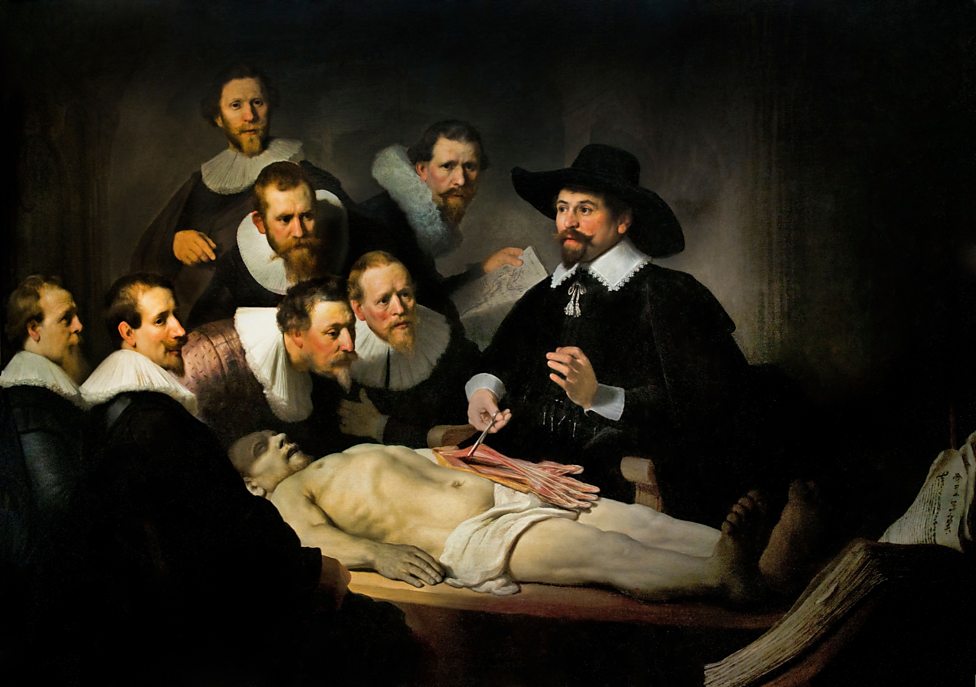
Afterward, his body was dissected, and pieces of his skin were used to make various items, including that wallet. His skeleton is still on display.J.K. Rowling drew directly from this history for her dark shops in Knockturn Alley.
Look over here! This shop used to be a junk shop, one I’ve visited many times. They sold joke items—like fake blood capsules, so you could pretend to be bleeding from the mouth—very similar to Fred and George’s Skiving Snackboxes. Can anyone tell me the names of the joke shops in Harry Potter?Yes, that’s right! Weasleys’ Wizard Wheezes and Zonko’s. J.K. Rowling must have had this place in mind when she wrote those scenes.

Now, we’re going to head to Greyfriars Kirkyard, Scotland’s most haunted graveyard. But how do we get to a graveyard? That’s right, by using a Portkey! Everyone, put your hands on it—let’s go!
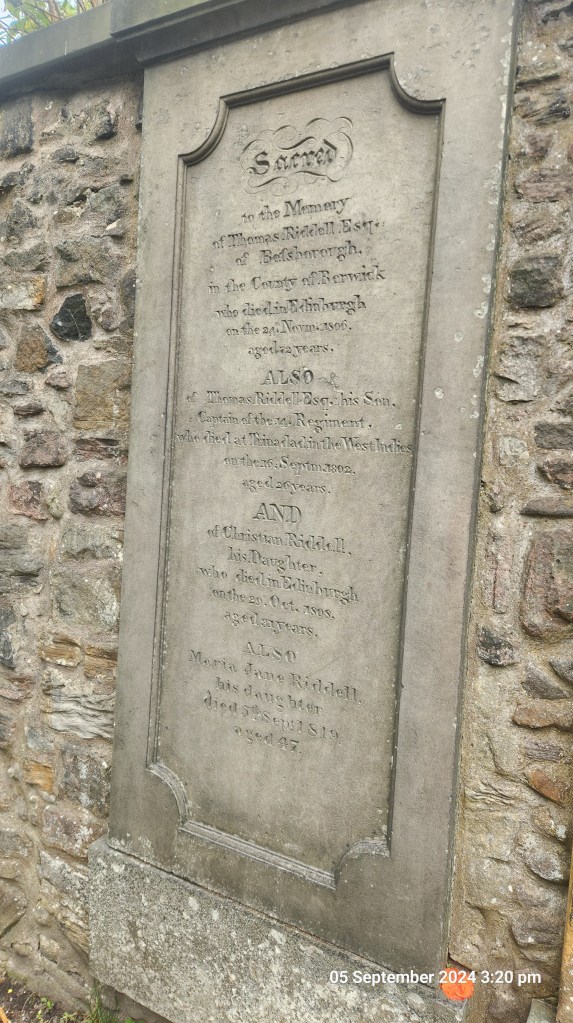
This graveyard was featured in some scenes of the Harry Potter films. It’s located on the site of a Franciscan monastery, where the friars wore grey habits. However, in 1562, Mary, Queen of Scots, converted it into a graveyard. The nearby graveyard at St. Giles was becoming overcrowded with bodies, so they decided to establish a new one here.I have to ask everyone to be very careful while we’re inside. I have a license to conduct tours here, and it strictly states that my group cannot walk on the grass—and for a good reason.
Although there are only 700 marked graves in this graveyard, there are actually around 250,000 people buried here. This was a plague pit, and many bodies were buried only a short distance beneath the surface. When it rains, the ground becomes muddy, and with people walking over it, things can get churned up that we’d rather not see.
Just over there, by that tree where the roots are, I’ve personally seen human teeth. Other guides have reported finding finger bones, pelvic bones, and just a few months ago, a skull was discovered during a Harry Potter tour. So, if you do come across something, please don’t pick it up.

 Every Brilliant Little thing